- 2427 Vista Drive Bellingham, WA 98229
- les@leszbees.com
- 1-360-303-0396

🐝🐝🐝 Les’s Bees Newsletter – Preparing Hives for Winter in the Pacific Northwest 🐝🐝🐝
August/September Edition
Hello friends,
It’s been a while, eh? I failed in my plan for a monthly newsletter… again (Big Sigh). BUT, on the positive side, I was able to answer lots of good questions from many of you through text messages and phone calls. Questions on how I would handle a situation are always welcome. Just letting me know how things are going are, too!
We’re approaching what is probably the most important time of our beekeeping year.
As the summer days shorten, it’s time to start preparing our colonies for the long, wet, and chilly Pacific Northwest winter. Bees that are healthy, well-fed, and protected now will be the ones that will survive and be ready for the first pollen production and nectar flows, come spring.
Here are some suggestions to help your colonies overwinter successfully in the PNW:
ENSURE YOUR BEES ARE FAT AND HIVES HAVE PLENTY OF STORES
- I feed Global 4% Pollen Patties with Complete Bee to help fatten them up and improve their gut health.
- Colonies in the PNW typically need 60–90 pounds of honey to survive the winter.
- I check each hive’s weight by weighing each side with a luggage scale and add those 2 numbers together for the total. I feed 2:1 sugar syrup until each of my hives weigh 120lbs+. The bees will take syrup until nighttime temps are consistently below 50°F. Be sure to finish your feeding so that the bees will have time to process and cap the honey before it gets too cold.
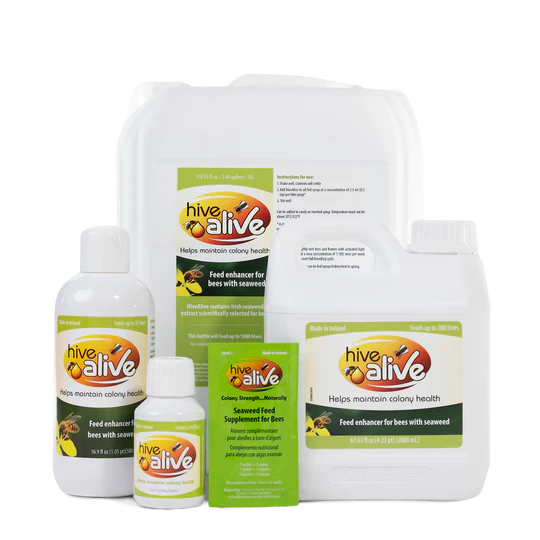
- To mix 2:1 syrup, I bring the water to a boil, pour into a container, and add the sugar while stirring. I have a bunch of hives, so a little more than 1 ½ gallons of HOT water with 25 lbs of sugar does it. I use a paint mixer on my drill to mix it. I also add HiveAlive Liquid to all of my syrup. It’s good insurance that your syrup won’t ferment even if the bees don’t get it all dried.
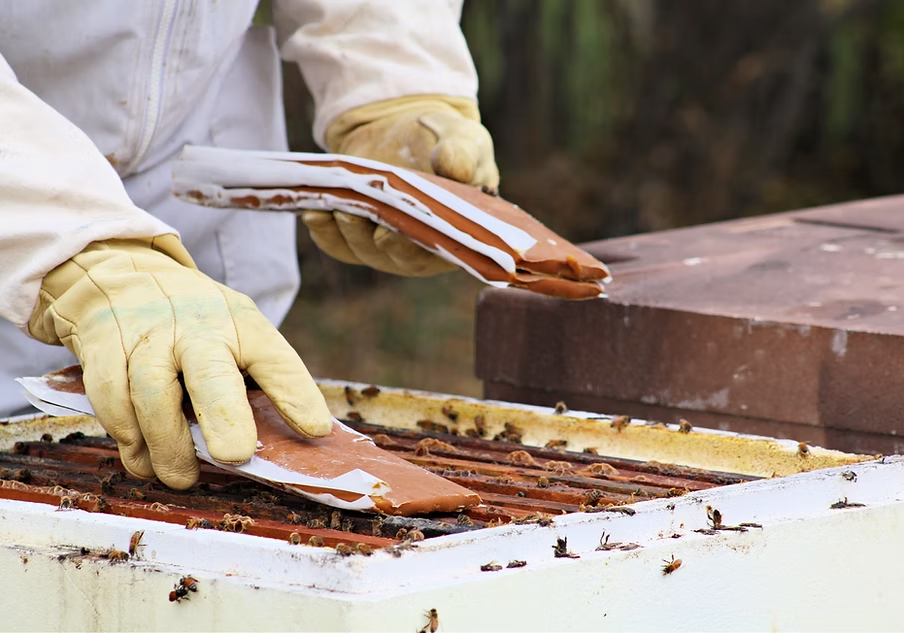
- Candy boards, camp-style sugar, and fondant can all be used as good insurance against starvation.
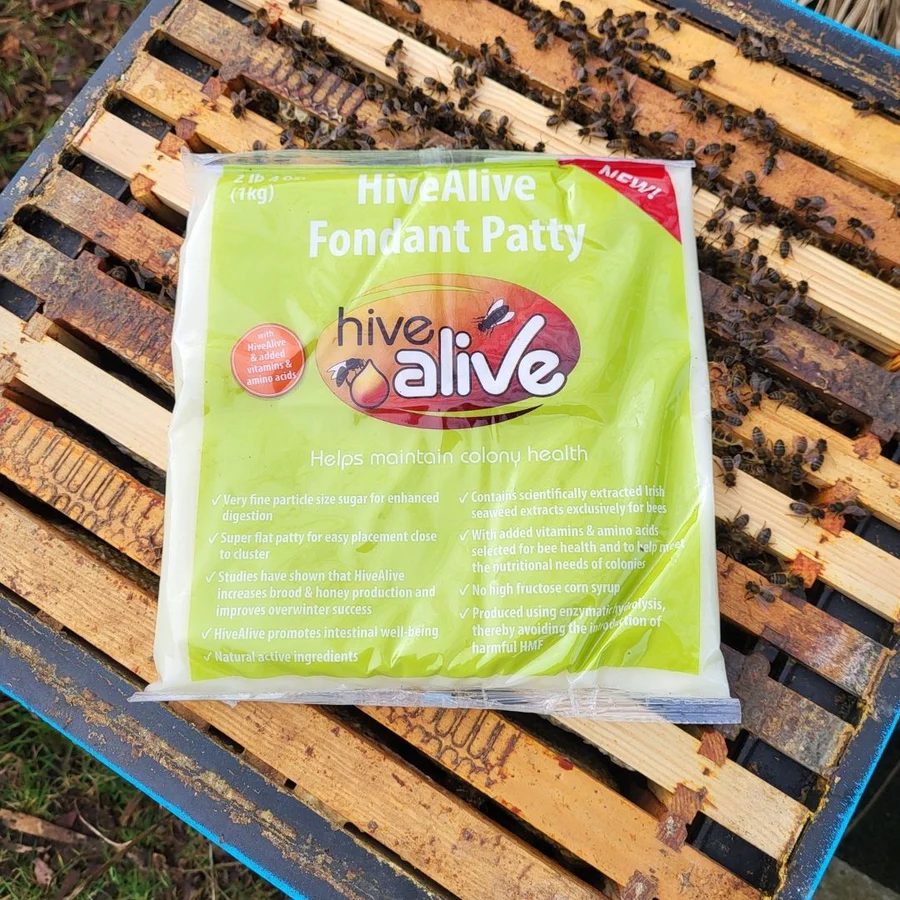
- The only fondant we have available in our area is HiveAlive. It’s a great supplement to add in early spring if we’re worried our bees are low on stores.
2. CONTROL VARROA MITES!!!
- Healthy bees going into winter are essential. High mite loads weaken colonies and spread viruses that shorten bee lifespan.
- The official recommendation is to test mite levels and treat if necessary. Apiguard, Formic Pro, or Oxalic Acid (dribble or vaporization) is commonly used.
- My program: I use Oxalic Acid Sponges year-round. I try to change them out at 90 day intervals. I begin using Oxalic Acid Vapor as soon as honey is off and check the mite trays on my screened bottom boards after 5 days for mite drop. I repeat until I’m satisfied the hives are at a healthy level. Then, in December, I begin OAV treatments in earnest and work to get my mite levels down near zero by the solstice.
3. REDUCE MOISTURE, NOT BY VENTILATION.
- Our biggest winter killer in the PNW isn’t the cold—it’s moisture.
- Tilt hives slightly forward so rain runs out and doesn’t pool up if you have solid bottom boards.
- I DO NOT ventilate my hives. (Check insulation in the next topic.)
- A quilt box (wood shavings in a box above the inner cover) can remove any doubt about too much moisture in the hive.
4. CONDENSE AND INSULATE.
- Reduce hive volume to what the bees need – usually a double deep or single deep plus a medium.
- Remove empty or partially full supers. The upper box should be full of stores because that’s where the bees will end up during the coldest and wettest period of winter.
- Your level of insulation is up to you. But, BE SURE THE TOP HAS MORE INSULATION THAN THE SIDES!
5. FEED POLLEN PATTIES (LATE SUMMER/EARLY FALL).
- Fat bees will be healthier and ready to feed the small amounts of brood over winter and the ramp up in late winter/early spring.
- Stronger colonies going into fall = healthier clusters through winter and a smooth buildup in spring.
6. FINAL CHECKLIST BEFORE WINTER.
✔ LOW MITE LEVELS!!! ✔ Adequate food stores. ✔ Reduced entrances (mouse guards on).
✔ Strong colonies (combine weak hives).
CLOSING THOUIGHTS.
The Pacific Northwest presents unique challenges—cool, damp weather, long rainy spells, or few early spring pollen sources and nectar flows. But with careful fall preparation, your bees can come out of winter healthy and ready for an early start come spring.
Here’s to strong colonies and a sweet spring ahead! And don’t forget to support your local bee supply business! I have all of your winterizing needs in stock. And I’m always happy to answer any questions that you may have.
🐝 Warm regards,
Les at Les’s Bees