
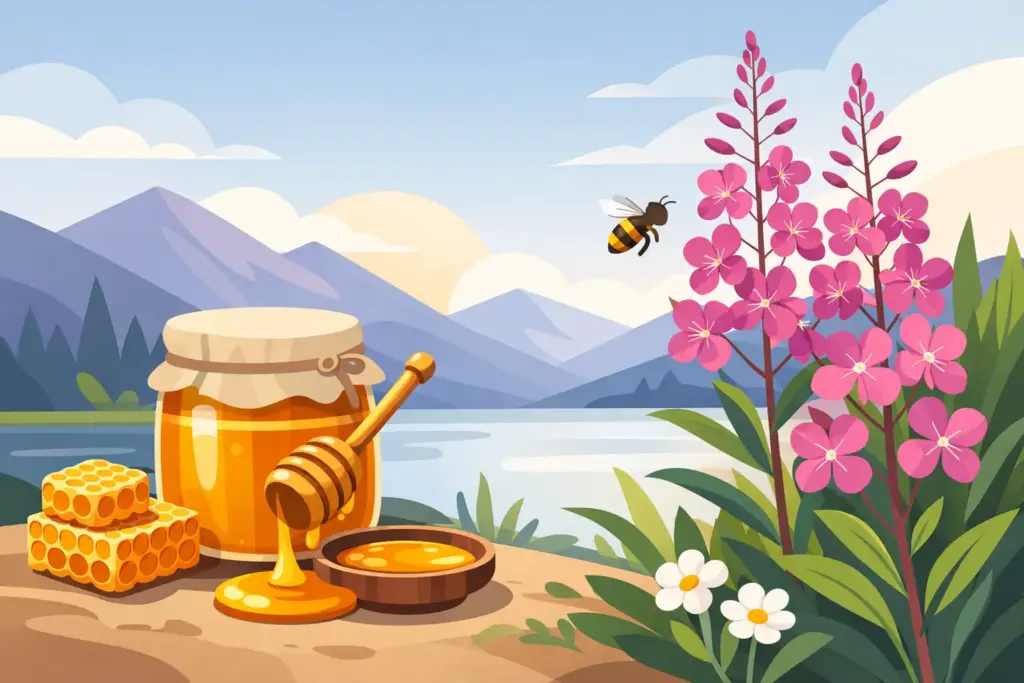
A jar of good fireweed honey can surprise people who expect honey to be dark, heavy, or sharply sweet. Fireweed honey benefits and taste are tied to one basic fact: it comes from a major Pacific Northwest wildflower bloom, often gathered during the bright, fast-growing part of summer. When the nectar flow is clean and well separated from other forage, the result is usually a pale, smooth honey with a delicate floral finish.
For customers who care where their food comes from, fireweed is more than a label. It is a seasonal snapshot of the landscape and the bees working it. Its flavor, color, and texture can vary from one harvest to the next, but a well-produced local jar has qualities that make it a favorite for people who want a lighter table honey without giving up character.
What Fireweed Honey Tastes Like
Fireweed honey is commonly light amber to nearly water-white when liquid. The flavor is mild compared with bold blackberry, knotweed, or late-season wildflower honey. Expect a clean sweetness, soft floral notes, and sometimes a faint buttery, pear-like, or herbal finish. It generally lacks the molasses-like depth found in darker honeys.
That mildness does not mean it is flavorless. Good fireweed honey has a clear, polished taste that works especially well where you do not want the honey to take over. Stir it into tea, spoon it over plain yogurt, use it in a vinaigrette, or spread it on warm bread and butter. It is also a good choice for baking when you want sweetness and moisture but not a heavy honey flavor.
The exact taste depends on the forage area and the beekeeper’s harvest timing. Bees rarely work a single flower with laboratory precision. A jar labeled fireweed may carry small contributions from clover, berries, willowherb relatives, or other nearby blooms. Weather matters too. A cool, wet bloom, drought conditions, or a strong competing nectar flow can all shift the final flavor.
Why the color can be so light
Fireweed nectar often produces a notably pale honey. Light color is one reason it is popular as a gift or pantry honey, but color alone does not prove purity or quality. Honey can darken with age, warm storage, and heating. A raw, unheated honey handled carefully will still vary naturally from batch to batch.
For the best read on a jar, use your senses. Look for a clean appearance, smell for a light floral aroma, and taste it at room temperature. Cold honey mutes flavor, while overheated honey can lose much of the aroma that makes a varietal honey interesting in the first place.
Fireweed Honey Benefits: What It Can and Cannot Do
Honey is primarily a natural carbohydrate food, made mostly of fructose and glucose, with water, enzymes, organic acids, minerals, and plant compounds in much smaller amounts. Fireweed honey provides quick energy and brings a flavor profile that can make it an easy swap for refined sweeteners in some everyday uses.
Like other honeys, it contains naturally occurring antioxidant compounds, though the amount varies with floral source, handling, and storage. Darker honeys often test higher for certain antioxidants, so fireweed should not be sold as the strongest choice simply because it is a specialty varietal. Its practical advantage is different: people enjoy its mild flavor enough to use a little thoughtfully rather than reaching automatically for processed syrup or white sugar.
Raw, unheated, unfiltered honey may retain more of its natural pollen, enzymes, and aroma than honey that has been heavily heated and finely filtered for long shelf display. Those qualities matter to many local-honey buyers, especially when they want food in a less processed form. They do not turn honey into a medicine, and they should not be treated as a cure for allergies, colds, or other health conditions.
Honey can be soothing in warm tea or as part of a simple home remedy for an irritated throat. For adults and children over age one, it is a familiar kitchen staple. Never give any honey, including fireweed honey, to an infant under 12 months because of the risk of infant botulism. And if you are managing blood sugar, remember that honey is still a concentrated sweetener. Variety does not change that.
A useful sweetener, not a miracle food
The most honest way to think about fireweed honey benefits is as a combination of food value, enjoyable flavor, and less processing when you choose raw local honey. It can replace sugar in a cup of tea, help balance tart fruit, or add a little energy before a hike or a long day in the bee yard. But portion size still matters.
Honey is sweeter than granulated sugar, so you can often use less. In baking, start by replacing one cup of sugar with about two-thirds to three-quarters of a cup of honey, then reduce other liquids slightly and lower the oven temperature a bit to account for faster browning. Fireweed’s lighter profile is particularly forgiving in cakes, muffins, and dressings.
Why Fireweed Is a Pacific Northwest Favorite
Fireweed is one of the plants people notice after disturbance. It can be abundant along roadsides, clearings, logged areas, and mountain corridors, sending up tall stalks with bright pink-purple flowers. In the right locations, a broad bloom can give bees a substantial nectar flow after earlier spring forage has slowed.
That does not mean every Pacific Northwest beekeeper can make a true fireweed crop every year. Colonies need to be strong at the right time, weather needs to cooperate, and the apiary needs access to enough fireweed for the bees to favor it over other sources. A few fireweed plants in the backyard will not produce a fireweed honey harvest.
For beekeepers, this is a useful reminder that varietal honey starts with forage planning. Know what blooms around each yard, watch colony strength before the flow, and add honey supers before the bees crowd the brood nest. If you are hoping to harvest a recognizable varietal, pull and extract supers close to the end of that bloom rather than letting several major nectar flows blend together.
Crystallization Is Normal
Fireweed honey is known for crystallizing, often into a fine, creamy texture when handled well. Crystallization is a natural change in honey, not a sign that it has spoiled or that sugar was added. Its speed depends on the ratio of natural sugars, moisture level, pollen particles, storage temperature, and whether crystals have already formed in the jar.
Some people prefer fireweed honey after it has set because the texture becomes easy to spread and the flavor feels especially smooth. Others want it pourable. If you want to soften crystallized honey, place the jar in gently warm water and give it time. Avoid boiling water, microwaving, or prolonged high heat. Excessive heat can damage the aroma and the raw qualities you bought it for.
Store honey tightly sealed at room temperature, away from direct sunlight. Refrigeration generally speeds crystallization, so it is not necessary for a normal pantry jar. Honey keeps exceptionally well when protected from moisture and contamination, though its freshest floral character is most noticeable when enjoyed within a reasonable time after harvest.
Choosing a Good Jar of Fireweed Honey
Ask where the honey was produced, whether it was heated, and whether it is a seasonal local harvest rather than a generic blend. A local beekeeper should be able to tell you something about the area, the harvest season, and how the honey was handled. Transparency matters more than an unrealistically uniform color or a flashy health claim.
At Les’s Bees, raw local honey is kept straightforward: honey should taste like the flowers and the place the bees worked. If you enjoy mild, floral honey with a clean finish, fireweed is worth keeping on the table. Try it first on something plain – toast, biscuits, yogurt, or a spoonful by itself – and let the season in the jar speak for itself.