
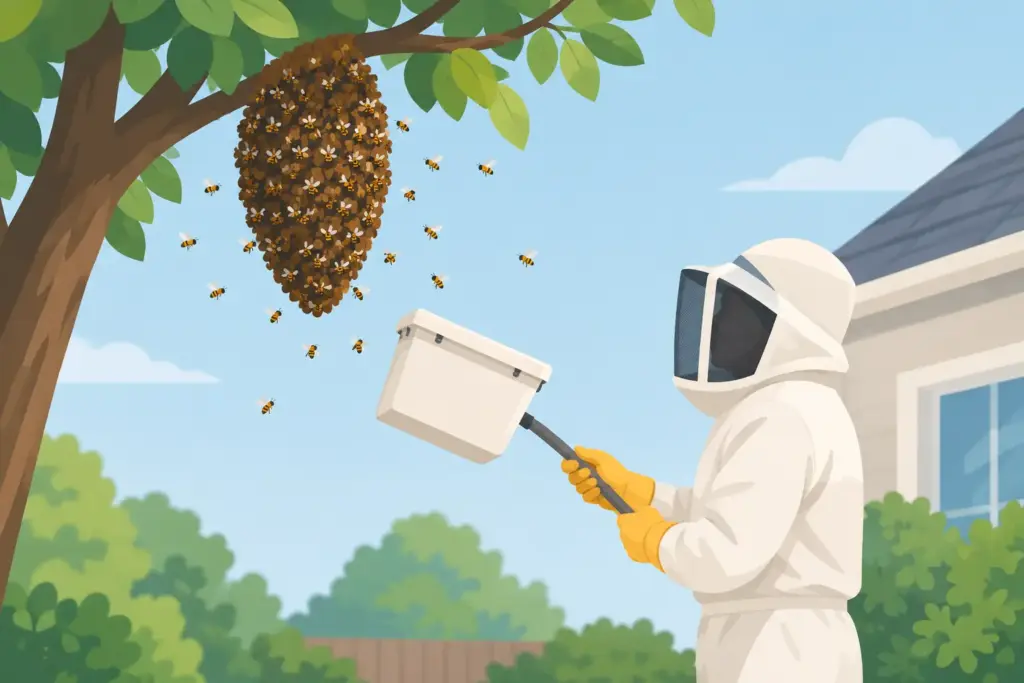
A honey bee swarm removal service is often the right call when thousands of bees suddenly gather on a branch, fence, post, shed, or other exposed spot. It can look alarming, especially if you have children, pets, or neighbors close by. But a true honey bee swarm is usually at its most manageable while it is clustered in the open and looking for a permanent home.
The first job is to slow down. Do not spray the bees, knock the cluster down, run a hose over it, or try to bag them yourself. A swarm is not the same as an aggressive nest. These bees have left a hive with their queen and are carrying stored honey, but they generally do not have brood or a home to defend. That does not mean they cannot sting, particularly if squeezed, disturbed, or handled roughly. It does mean a calm, timely collection by a beekeeper can often save the colony and remove the immediate concern from your property.
What a Honey Bee Swarm Looks Like
A swarm normally appears as a dense, hanging ball or teardrop-shaped mass of bees. It may be the size of a softball, a basketball, or larger. You may also see a cloud of flying bees around it at first, followed by a quieter cluster once they settle. Swarms commonly land on low tree limbs, shrubs, gates, porch railings, outdoor furniture, or fence lines.
In Northwest Washington, swarm calls often begin in spring as colonies build quickly on early nectar and pollen. A strong hive can become crowded, raise a new queen, and divide. The original queen leaves with a large share of the workers while a new queen remains behind in the old hive. Weather, forage, colony genetics, and how much room a colony has all affect timing, so swarms can still occur later in the season.
A swarm may stay in one location for only a few hours. Others remain overnight or for several days. Scout bees are searching for a suitable cavity, and once the colony agrees on a location, it can leave with little warning. That is why calling early gives a beekeeper the best chance of collecting the bees before they move into a wall, chimney, attic, or hollow tree.
Make Sure They Are Honey Bees
Honey bees are fuzzy, brown-and-gold insects with fairly compact bodies. A cluster of them often looks like a living blanket of bees hanging together. Yellowjackets, paper wasps, and hornets have smoother bodies, narrower waists, and are more likely to be flying in and out of a visible paper nest or ground hole.
If insects are entering a gap in siding, a vent, roofline, or wall cavity, that is no longer a simple exposed swarm. It may be an established honey bee colony, or it may be another stinging insect altogether. Photos from a safe distance can help identify what you are dealing with, but do not get close just to take one.
When a Swarm Catch Is a Good Fit
An exposed cluster that can be reached safely is the ideal swarm-catching situation. A beekeeper can place a box beneath the cluster, gently transfer the bees, and confirm that the queen has gone into the box. Once the queen is inside, the remaining workers usually follow.
Access matters. Bees clustered six feet up on a fruit tree are very different from bees hanging 30 feet above a driveway, wrapped around a power line, or positioned behind a second-story dormer. A responsible beekeeper will ask where the swarm is located, how high it is, whether a ladder is needed, and whether there are hazards such as traffic, loose ground, dogs, overhead utilities, or a difficult gate.
A few details make it easier to assess the call: the address or general area, a clear photo, the approximate size of the cluster, its height from the ground, when you first noticed it, and whether bees are entering a structure. Keep your distance while gathering that information. You do not need to test whether they are calm.
At Les’s Bees, swarm-catching support is approached as practical beekeeping work, not a promise that every bee situation can be handled the same way. A reachable swarm may be a straightforward collection. A colony inside a building can require a more involved removal plan, repair work after removal, or a specialist with the right access equipment.
What to Do While You Wait
Give the swarm space. Keep people, pets, lawn equipment, and curious neighbors away from the immediate area. If the bees are on a low branch near a walkway, use a chair, cone, tape, or another simple barrier to redirect foot traffic without touching the branch.
Avoid mowing, trimming, pressure washing, or using a leaf blower near the cluster. Vibrations and disturbance are unnecessary stress on bees that are already in transition. Do not block their flight path with sheets, bins, or improvised containers. The goal is not to trap them. The goal is to let a trained person collect them with the queen and enough workers to reestablish the colony.
If someone in the household has a serious bee-sting allergy, treat the situation with extra caution. Keep a wider buffer, avoid outdoor activity near the swarm, and contact a qualified local beekeeper or pest professional promptly. Emergency medical concerns always come before bee removal.
Why Spraying Is Usually the Wrong Answer
Spraying an exposed honey bee swarm may kill bees that could otherwise become a productive colony. It can also scatter surviving bees, complicate safe removal, and leave pesticide residue in the area. For homeowners who care about gardens, fruit trees, and local pollinators, that is a poor outcome when a collection is possible.
There is also a practical reason not to spray: chemicals do not solve the underlying issue if the bees have already entered a structure. Dead bees, honey, wax, and brood left inside a wall can attract pests and create staining or odor problems. A colony living in a building generally needs removal of the comb as well as the bees. Simply killing insects at an entrance can make a repair more difficult later.
That said, saving every colony is not always possible. Unsafe access, public safety risks, severe structural complications, or uncertain insect identification can change the decision. Good service starts with an honest assessment rather than telling every caller that a quick swarm catch is guaranteed.
Swarm Removal Is Different From a Cutout
Homeowners often use the word “swarm” for any group of bees on the property, but the difference matters. A swarm is temporary and exposed. A cutout is the removal of an established colony from a structure, often involving siding, soffits, roofs, walls, or floors. A trap-out is another approach used in certain situations, where bees are guided out over time, though it has its own limitations and does not remove all comb from the cavity.
Cutouts require more planning because honey bee colonies store honey and build wax comb. If bees have been living in a wall for months, removing the bees without addressing the comb can leave behind material that melts, leaks, attracts wax moths or rodents, and draws new swarms in later. The best method depends on the location, building materials, access, colony size, and who is responsible for repairs.
For a property owner, the useful question is simple: are the bees hanging in the open, or are they moving in and out of an enclosed space? That answer determines whether you likely need a swarm catch or a structural removal plan.
A Better Outcome for Bees and Beekeepers
A collected swarm can be given a hive box, frames, food if needed, and close monitoring while it establishes. Not every caught swarm turns into a strong colony. Some arrive with poor queen quality, limited stores, mites, or other challenges. Still, a healthy swarm has real value. It can become a productive pollination colony, a honey producer, or a local source of bees for another beekeeper.
For local beekeepers, swarm calls are also a reminder to stay ahead of crowding in their own yards. Give growing colonies room at the right time, inspect for queen cells during the spring buildup, and keep spare equipment ready. A nuc box, extra deep or medium boxes, drawn comb when available, frames, feeders, and a marked queen plan can turn a swarm season surprise into a manageable expansion opportunity.
If a cluster of bees lands on your property, take a photo from a safe distance, protect the area around it, and make the call sooner rather than later. The best chance to move a swarm safely is while it is still visible, reachable, and waiting for its next home.