
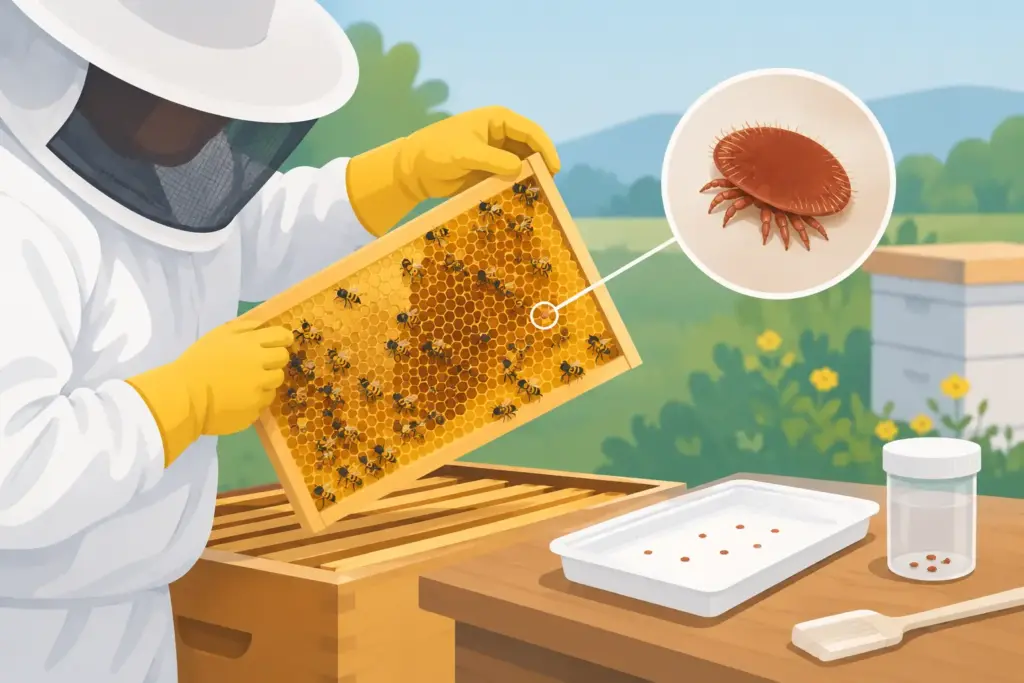
A colony can look busy, calm, and packed with brood while varroa is steadily shortening the lives of the bees that must carry it through winter. That is why learning how to test for varroa mites is not a once-a-year chore. It is a regular management habit, right alongside checking brood pattern, stores, and queen performance.
Varroa mites reproduce under capped brood, feed on developing and adult bees, and spread damaging viruses. By the time you see crawlers with deformed wings or a colony that simply cannot build up, the mite problem has usually been growing for weeks. Testing gives you a number before the colony gives you a warning sign.
Choose a Test That Gives You a Useful Number
For most backyard and sideline beekeepers, an alcohol wash is the most dependable field test. It gives a reasonably accurate mite count from a known sample of adult bees. It does require sacrificing about 300 bees, but that is a small cost when compared with losing a colony or allowing it to collapse and spread mites to nearby hives.
A powdered sugar roll can be used when you do not want to kill the sample bees. It is less consistent than an alcohol wash, especially in damp Pacific Northwest weather when sugar clumps and mites do not release well. It can still show that mites are present, but it is not the best tool for deciding whether treatment can wait.
Sticky boards have a place, particularly for tracking mite drop over time or checking whether a treatment is working. They do not sample the colony as directly as a wash, though. Natural mite drop changes with brood level, weather, grooming behavior, and colony size, so a sticky board count by itself can be misleading.
If you need one method to build your management around, choose the alcohol wash.
How to Test for Varroa Mites With an Alcohol Wash
You need a wash cup or two-piece mite shaker, rubbing alcohol, a white tray or bucket, a measuring scoop, and a way to record the result. Many beekeepers use windshield washer fluid because it is inexpensive and makes the mites easier to see, but rubbing alcohol works well. Keep the fluid away from children, pets, honey supers, and open feed.
The key to a useful sample is collecting the right bees. Varroa hitchhike on adult bees, but the bees most likely to carry mites are nurse bees working near open brood. Do not scoop bees from the honey supers, hive entrance, or outer frames. Those are more likely to be foragers, and a forager sample can understate your mite level.
1. Find a brood frame without the queen
Pull a frame with open brood and plenty of young bees. Take a moment to locate the queen or set aside any frame where she may be present. Accidentally washing a queen creates a far bigger problem than a bad mite count.
Hold the selected brood frame over an open hive box or a spare box and shake the bees off. The older bees often fly up quickly, while nurse bees remain in the pile. Gently scoop a half-cup sample, roughly 300 bees, into the wash container.
A level half-cup is a practical standard, but consistency matters as much as precision. Use the same scoop and method each time so your records mean something.
2. Add fluid and agitate the sample
Pour in enough alcohol or washer fluid to completely cover the bees. Seal the lid, then swirl or shake the container firmly for about 30 seconds. Let it rest for another 30 seconds, then shake again. The goal is to dislodge mites from the bees, not to rush through the test.
Strain the liquid through the screened section of the shaker into a white tray or bucket. Rinse once more with clean fluid if your equipment allows it. Mites are small, reddish-brown, and oval. Against a white background, they are easier to count than in a dark bucket or grass.
3. Count mites and calculate the percentage
Count the mites in the tray. Because your sample is about 300 bees, divide the mite count by three to get mites per 100 bees.
For example, six mites in a 300-bee sample equals 2 mites per 100 bees, or a 2% infestation. Fifteen mites equals 5 mites per 100 bees.
Write down the date, hive name, mite count, colony condition, and whether brood is present. A single number tells you where the hive is today. Several dated tests show whether the colony is holding steady or heading toward trouble.
When Should You Test Your Hives?
In Northwest beekeeping, the most critical mite decisions often happen from late summer into early fall. The bees raised then become the long-lived winter bees. If mites and virus are high while those bees are developing, a colony can look acceptable in September and still dwindle badly before spring.
Test at least three times during the active season: once in spring after the colony has established brood, again before or around your main honey flow decisions, and again immediately after honey supers come off. In a heavy brood season, during a dearth, after a swarm, or when bringing in purchased bees or a new queen, testing more often is smart.
A practical schedule is every four to six weeks while brood is present. Test before treatment, then test again after the treatment window has ended. Do not assume a product worked just because you applied it. Confirm the result with another wash.
What Mite Count Calls for Action?
There is no one number that fits every colony, region, and season. Brood volume, local reinfestation pressure, neighboring unmanaged colonies, and the time of year all matter. Still, a commonly used action point is around 2 mites per 100 bees in spring and 3 mites per 100 bees later in the season.
In practice, do not use a threshold as permission to wait until the colony is in bad shape. A count near the action level deserves attention, especially when the colony is raising winter bees or mites are increasing quickly between tests. A 1% count that doubles in a month is more concerning than a stable 1% count in early spring.
If a colony is above your action threshold, choose a treatment that fits the season, temperature, brood conditions, and whether honey supers are on the hive. Follow the product label exactly. Treatment timing, dose, and temperature limits are not suggestions. Some products work best with little or no capped brood, while others can be used with brood present. Rotate treatment types when appropriate to reduce the chance of mite resistance.
Why Sugar Rolls and Sticky Boards Can Still Help
A sugar roll is useful for a beekeeper who is practicing the technique, screening a small group of colonies, or wants a nonlethal snapshot. Use very dry powdered sugar, warm and dry conditions, and a proper screened jar. Even then, treat a low sugar-roll result cautiously if the colony has a history of mite pressure.
Sticky boards are most useful when you use them as a trend tool. Place the board beneath a screened bottom board for a defined period, usually 24 to 72 hours, and compare results from the same colony over time. They can also show a noticeable post-treatment drop, which is useful information, but a follow-up alcohol wash remains the better measure of what mites are still on adult bees.
Avoid relying on visual inspections of drones, deformed-wing bees, or mites spotted on adult workers. Those observations can confirm that varroa exists, but they usually appear too late to guide good management.
Make Testing Part of Every Hive Record
Name or number every hive and keep a simple notebook, phone note, or inspection sheet. Record the wash result as mites per 100 bees rather than only writing “six mites.” That lets you compare colonies of different strength and see patterns from season to season.
Testing is also a good time to look at the whole colony. Is brood solid or scattered? Are there eggs and young larvae? Is the population matching the amount of brood? A mite number does not replace a full inspection, but it gives that inspection a clear, measurable piece of information.
A productive colony is not automatically a low-mite colony. Strong hives can raise a lot of brood and a lot of mites at the same time. The beekeepers who winter more colonies are usually not guessing which hives need help. They are testing, recording, and acting while there is still time.
If you need a wash cup, treatment options, or a second opinion on a test result, Les’s Bees can help you choose practical supplies for the season. Take the sample, write down the number, and let that number guide your next move before your bees are trying to survive a problem you could have measured.