

Waiting until 2026 to order your bees is the single biggest mistake a Pacific Northwest beekeeper can make. Every year, I get calls in March from anxious beekeepers, but by then, most quality, local suppliers are completely sold out of nucs and packages. It’s a frustrating cycle. You’re excited for the new season, but the fear of missing out and the confusion over our unpredictable weather can make getting started stressful.
You just want to know you’ll have a healthy colony ready to go at the right time. That’s why I created this complete timing guide. You’ll learn exactly when to buy bees for spring 2026 to guarantee your spot and set your hives up for a productive year. We’ll walk through the critical pre-order window that opens this fall, explain the pickup timing for nucs versus packages, and help you choose the right bees for a successful start.
Key Takeaways
- Learn the “golden window” for pre-ordering your bees to avoid missing out due to high local demand.
- Understand the key differences between nucs and packages to choose the right colony for your skill level and budget.
- Discover how Pacific Northwest weather patterns affect when to buy bees for spring 2026 and set your specific pickup date.
- Get a clear checklist of essential equipment to prepare before your bees arrive in April for a smooth installation.
The 2026 Beekeeping Calendar: Why Timing is Everything
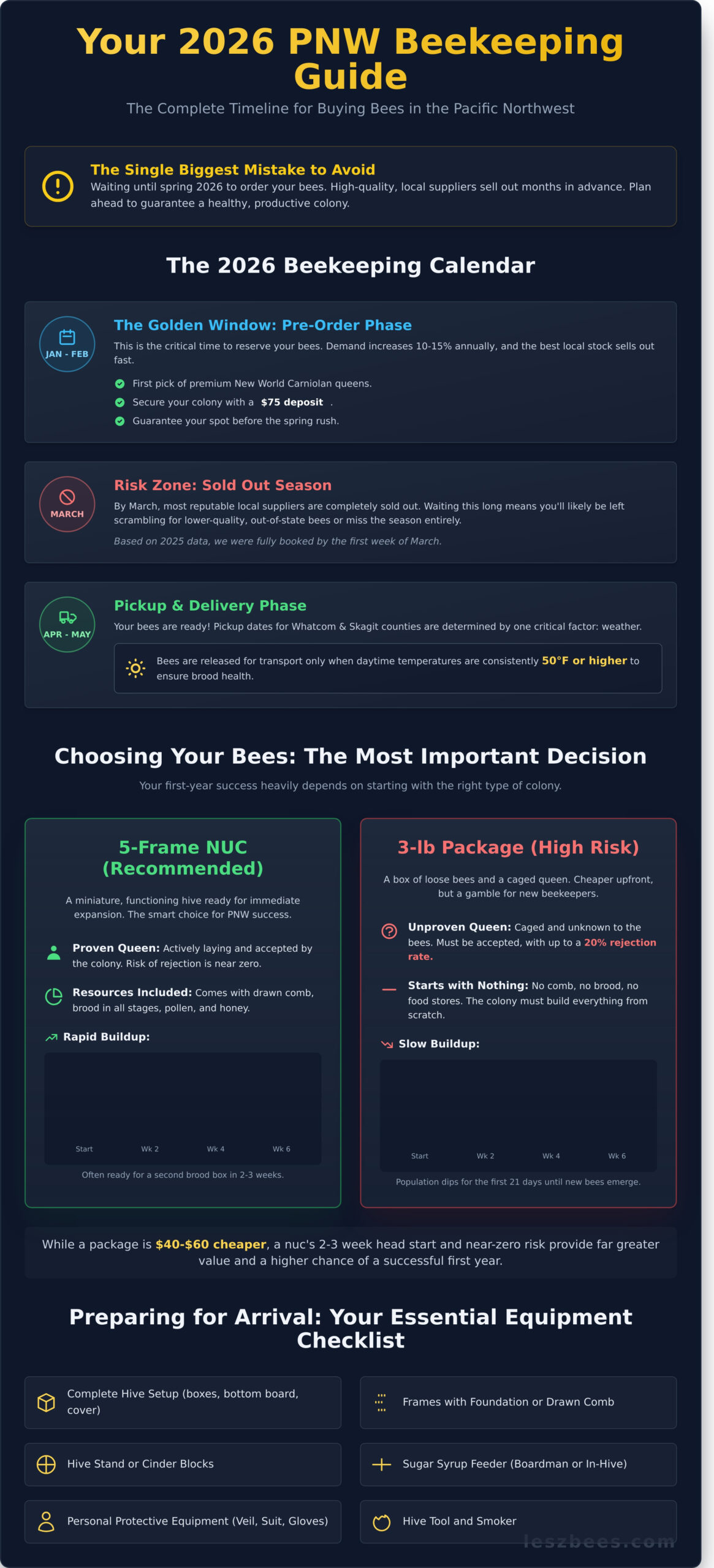
Success in beekeeping starts long before your bees arrive. The question of when to buy bees for spring 2026 has a simple answer: much earlier than you probably think. There is a critical difference between placing your order and taking delivery. Your goal is to reserve your spot during the “Golden Window,” which typically runs from early January through March.
Here in Washington, the demand for quality local bees consistently outpaces supply. Based on the last three years of data, we’ve seen a 10-15% year-over-year increase in pre-orders for nucleus colonies. By March 2025, we were completely sold out. I expect this trend to continue for the 2026 season. Waiting until April to find bees is a gamble that rarely pays off with healthy, local stock. For those just getting started, getting a comprehensive overview of beekeeping can help you understand why securing strong, locally adapted genetics early on is so vital for your first year’s success.
Do not wait. I personally recommend securing your bees by the end of February at the latest. This ensures you get the bees you want and aren’t left scrambling for lower-quality packages shipped from out of state. Your bees are the most important investment you’ll make.
The Pre-Order Phase (January – February)
The early bird gets the best bees. Ordering in January gives you the first pick of our premium New World Carniolan queens, which are known for their gentle temperament and rapid spring buildup. They always sell out first. To reserve your 5-frame nucleus colony (nuc), we require a $75 non-refundable deposit. This payment locks in your order and guarantees your bees will be ready for you in the spring.
The Delivery Phase (April – May)
Your bees will be ready for pickup when the weather is right. Our pickup window for Whatcom and Skagit counties typically runs from the last week of April through the second week of May. The final date is entirely dictated by spring weather patterns here in the Bellingham area. I won’t release any bees for transport until we have consistent daytime temperatures of 50°F or higher. This ensures the brood stays warm and the colony remains healthy during the move to your apiary.
Choosing Your Bees: Nucs vs. Packages for Spring 2026
Once you’ve decided on the timing for your order, the next big question is what you are actually buying. The choice between a nucleus colony (nuc) and a package of bees is one of the most important decisions a new beekeeper will make. Your success in the first year often depends on this choice. While packages are cheaper, I believe the risks far outweigh the savings, especially here in Washington.
A package of bees is essentially a 3-pound box of loose, unrelated bees with a caged queen shipped from a large-scale producer, often in California or Georgia. The main appeal is the price, which can be $40 to $60 less than a nuc. However, this is a risky start. The bees have no comb, no brood, and no food stores. You are asking a disorganized group of bees to build a home from scratch while also accepting a queen they’ve never met. Queen rejection rates can be as high as 20% with packages. For a new beekeeper, a failed queen is often a failed hive. Getting the fundamentals right is critical, and a package offers zero margin for error. Beginners should focus on mastering the Beekeeping Basics before attempting the challenge of installing a package.
The Benefits of a 5-Frame Nuc
A 5-frame nuc is a miniature, functioning hive ready for expansion. It contains a proven, laying queen, frames of brood in all stages, and frames of pollen and honey. This gives your colony a 2-to-3-week head start over a package. Because the queen is already accepted and laying, the risk of rejection is almost zero. You get a colony that is already working as a cohesive unit.
The difference is clear when you look at the buildup speed for the 2026 nectar flow. Here’s a direct comparison:
- 5-Frame Nuc:
- Queen: Proven and actively laying.
- Resources: Comes with drawn comb, brood, pollen, and honey.
- Buildup: Begins expanding population immediately. Often ready for a second brood box within 2-3 weeks.
- Risk: Very low. The colony is already established.
- 3-Pound Package:
- Queen: Unproven and caged, must be accepted by the bees.
- Resources: Starts with nothing. Must draw all comb from foundation.
- Buildup: Population dips for the first 21 days until new bees emerge. Can take 4-6 weeks to reach the same strength as a starting nuc.
- Risk: High. Queen rejection, absconding, and slow buildup are common issues.
My take is simple. For local success, a nuc is the smart choice. The initial investment pays for itself with a stronger, more productive colony that has a much higher chance of survival. This is why when you think about when to buy bees for spring 2026, you should also be thinking about buying the right bees. For beekeepers in Whatcom County, I always recommend starting with one of my proven, locally-raised 5-frame nucs.
New World Carniolan Queens: The PNW Favorite
The bees I raise are centered around New World Carniolan queens. This specific genetic line is perfect for our damp, cool springs in the Bellingham area. They are known for their explosive spring buildup, quickly growing the colony to take full advantage of the early nectar flows. They are also famously gentle, which makes hive inspections much more pleasant for backyard hobbyists. Their traits give you the best possible start for a strong 2026 season.
Regional Factors: When to Buy Bees in Washington State
Washington is not California. Our cool, wet springs create a unique set of challenges you won’t find in other parts of the country. Understanding our local climate is the single most important factor in deciding when to buy bees for spring 2026. A week or two can make the difference between a thriving colony and a dead-out.
The North Cascades create a rain shadow effect that gives beekeepers in eastern Skagit and Whatcom counties a slightly different timeline than those right on the water in Bellingham. While the Big Leaf Maple might start producing pollen in late February, consistent flying weather often doesn’t arrive until April. A classic Pacific Northwest “false spring” in March can trick southern bees into ramping up brood production, only for them to starve when a cold, 10-day rainy spell hits in April.
This is why getting your bees too early is a huge risk here. Your goal should be to have your colony installed and building strength just as reliable forage becomes available. For most of our area, this means the main nectar flow from dandelions and fruit trees in mid-to-late April, leading into the massive blackberry bloom in late May.
Climate-Driven Deadlines
I time my nuc availability to what I call the “Big Bloom” window here in Whatcom County. This is when there’s enough consistent forage to support a new colony’s explosive growth. That’s why a local source matters. My bees are raised in Bellingham. They are genetically adapted to our long, wet winters and unpredictable springs. Southern bees, imported from places like Georgia or California, are programmed for a different calendar. They can’t handle our weather swings.
You can tell if a supplier is selling local stock by asking one simple question: “Where were these bees overwintered?” If the answer isn’t Whatcom, Skagit, or a nearby Washington county, you are likely buying southern imports that are not prepared for our climate.
Avoiding the “Spring Dwindle”
The “Spring Dwindle” happens when a colony starts strong but then shrinks and starves because it can’t forage during a cold, wet April. The best way to avoid this is with proper timing. While you should plan to install your bees in mid-to-late April 2026, the deadline to purchase them is much sooner. Many beekeepers follow the expert advice of ordering bees in the fall or early winter to guarantee availability. My nucs are typically sold out by January each year. Planning ahead is not optional.
No matter when your bees arrive, you must have sugar syrup ready. A 1:1 syrup mix is cheap insurance against a sudden cold snap. I take pride in timing our nuc releases for maximum survival rates. I will not sell you bees in March just to be first. My reputation depends on your success, and that starts by releasing healthy, local bees when they have the best chance to thrive, usually around the third or fourth week of April.
The Pre-Order Process: How to Secure Your 2026 Colony
You’ve done the research and learned the best timeframes for when to buy bees for spring 2026. Now it’s time to act. Placing a pre-order is the only way to guarantee you get a healthy, local colony when you need it. Our bees sell out every year, usually by late January. Waiting until March or April is too late. Here is our simple process for reserving your bees and why getting them directly from us makes all the difference.
I stand behind every bee I sell. Before any nuc or package leaves my apiary, I personally inspect it to ensure it has a healthy, laying queen and the right amount of brood and resources. This isn’t a factory; it’s a local operation dedicated to your success. That’s my personal quality check, and your satisfaction is guaranteed.
Placing Your Order
Securing your bees is straightforward. First, navigate to our live bees section to see our 2026 availability. You will need to decide on the quantity of packages or nucs you need and whether you want a marked or unmarked queen. A marked queen has a small, colored dot on her thorax, making her much easier to find during hive inspections. This costs a few dollars more but saves new beekeepers a lot of time and stress. Once you complete your reservation, you will receive a confirmation email. Please save this email; it contains your order number and pickup details. Check availability and reserve your 2026 bees today.
Local Pickup vs. Shipping
We prioritize local pickup at our Bellingham, WA location for one simple reason: it’s better for the bees. Shipping live animals through the mail is incredibly stressful for them. A shipped package can experience temperature fluctuations of over 40°F and rough handling, which can lead to a 15% or higher rate of queen death or failure upon arrival. You avoid all that risk with local pickup.
Buying from a local source like Les’s Bees means your colony has a 5-minute car ride, not a 3-day journey in a dark box. The big online sellers can’t offer that. They can’t guarantee the bees weren’t sitting on a hot loading dock or a cold truck for hours. When you pick up from me, you get healthy, calm bees ready for their new home.
For pickup day, please come prepared. Plan to arrive during your designated time slot to keep things running smoothly. You should bring:
- Protective Gear: At a minimum, bring your veil. Bees will be flying.
- Transport Safety: Ratchet straps or rope to secure nuc boxes in your truck bed. For transport inside a vehicle, a large mesh laundry bag is an excellent way to contain any stray bees.
- Vehicle Prep: Ensure your vehicle has adequate ventilation. Never leave bees in a hot, sealed car.
Preparing for Arrival: What to Do While You Wait
You’ve figured out when to buy bees for spring 2026, and your nuc or package order is confirmed. That’s the easy part. A successful first year depends entirely on what you do between now and pickup day in April. Don’t wait until the last minute. A prepared beekeeper is a successful beekeeper.
Your first priority is your equipment. Get your woodenware assembled and painted weeks before your bees arrive. I see it every year: a new beekeeper picks up their bees on April 20th and has to rush home to assemble boxes. This is stressful for you and the bees. Build your hives now, giving any paint at least three weeks to cure so the fumes are gone. Have at least two deep brood boxes and one Western honey super per hive, fully assembled with frames and foundation. This gives your colony room to grow without delay.
For beekeepers here in the Pacific Northwest, I strongly recommend HiveiQ thermally superior hives. Our cool, damp springs can be tough on a new colony struggling to build up. Standard pine boxes offer minimal insulation. HiveiQ hives are engineered to provide an R6.5 insulation value, which helps the bees maintain a stable 95°F brood nest temperature with less effort. This means they consume fewer resources and can focus on expansion. I’ve seen colonies in these hives build up 20-30% faster in their first year compared to those in traditional wood.
You also need to order your personal gear early. Protective suits, veils, gloves, and smokers see a massive surge in demand from February to April. Shipping times can easily double from 5 business days to 10-14 days. Order your gear by January 31st to guarantee it arrives with time to spare.
Finally, prepare the physical location for your hives. Your apiary site is critical. Look for a spot that meets these needs:
- Sunlight: The hive entrance should face east or southeast to catch the morning sun. This encourages the bees to start foraging earlier.
- Windbreak: Protect your hives from prevailing winds, especially from the north. A fence, hedge, or building works well.
- Water Source: Bees need water. A birdbath with stones or a dedicated bee waterer within 50 feet will keep them out of your neighbor’s pool.
Essential Equipment Checklist
For a new hive, you need deep brood boxes for the queen to lay eggs and the colony to raise brood. Western supers are smaller and lighter, used specifically for honey collection you intend to harvest. I personally choose every product in my shop for its quality and durability. You won’t find cheap, low-grade equipment here. Get a complete list with our Beekeeping Supplies Checklist.
Education and Planning
Equipment is only half the battle. Use this time to learn. Join a local group like the Whatcom County Beekeepers Association to connect with experienced mentors. Most importantly, map out your 2026 mite treatment strategy now. Decide if you’ll use an oxalic acid treatment on your package or a formic acid-based treatment later in the season. Knowing your plan before you have a problem is key. Success isn’t just about knowing when to buy bees for spring 2026; it’s about being ready when they land. Shop our 2026 beekeeping equipment now and be prepared.
Secure Your Bees for a Successful 2026 Season
Your success next year depends on the decisions you make now. Understanding when to buy bees for spring 2026-ideally pre-ordering between October 2025 and January 2026-is the most critical first step. This secures your spot before suppliers sell out. Choosing the right type of colony, like a nucleus hive with a locally-mated, proven queen, gives your bees a powerful start and sets you up for a strong honey flow as soon as the nectar starts.
For beekeepers in Washington State and the Pacific Northwest, a local source is your best advantage. At Les’s Bees, your Bellingham local source, I personally verify the quality of every single colony. You get healthy, PNW-hardy bees that are already adapted to our wet springs and cool summers. My prices are also kept much lower than the big online retailers, because I believe quality beekeeping supplies should be accessible to everyone.
Order Your 2026 Nucs and Queens from Les’s Bees today and guarantee your colony.
Here’s to a productive and rewarding 2026 season in your apiary!
Frequently Asked Questions
Is it too late to buy bees for the 2026 season?
No, it isn’t too late for when to buy bees for spring 2026, but my supply is limited and sells out fast. I typically see 75% of my nucs pre-ordered by January 15th each year. To guarantee you get your bees, placing your order before the new year is the best plan. After January, availability becomes very limited. Don’t wait and risk missing out on a successful season.
When is the best month to pick up my bees in Washington?
The best time for bee pickup in Washington is