

The cheapest all-in-one beekeeping kit you find online is often the most expensive mistake a new Washington beekeeper can make. I see it all the time. You get excited about starting, see a low price, and then get hit with huge shipping fees for a box of wood that might rot in our damp PNW climate. It’s frustrating, and it makes you question what you actually need to get started right.
That’s why I put this guide together. It’s a no-nonsense, transparent look at the real cost to start beekeeping in Washington for 2026. This article gives you a complete shopping list with local prices, so you can buy quality gear with confidence and avoid the sticker shock from national sellers. We’ll cover every essential piece of equipment, the bees themselves, and even the state registration requirements, ensuring you have everything you need for a healthy, thriving colony.
Key Takeaways
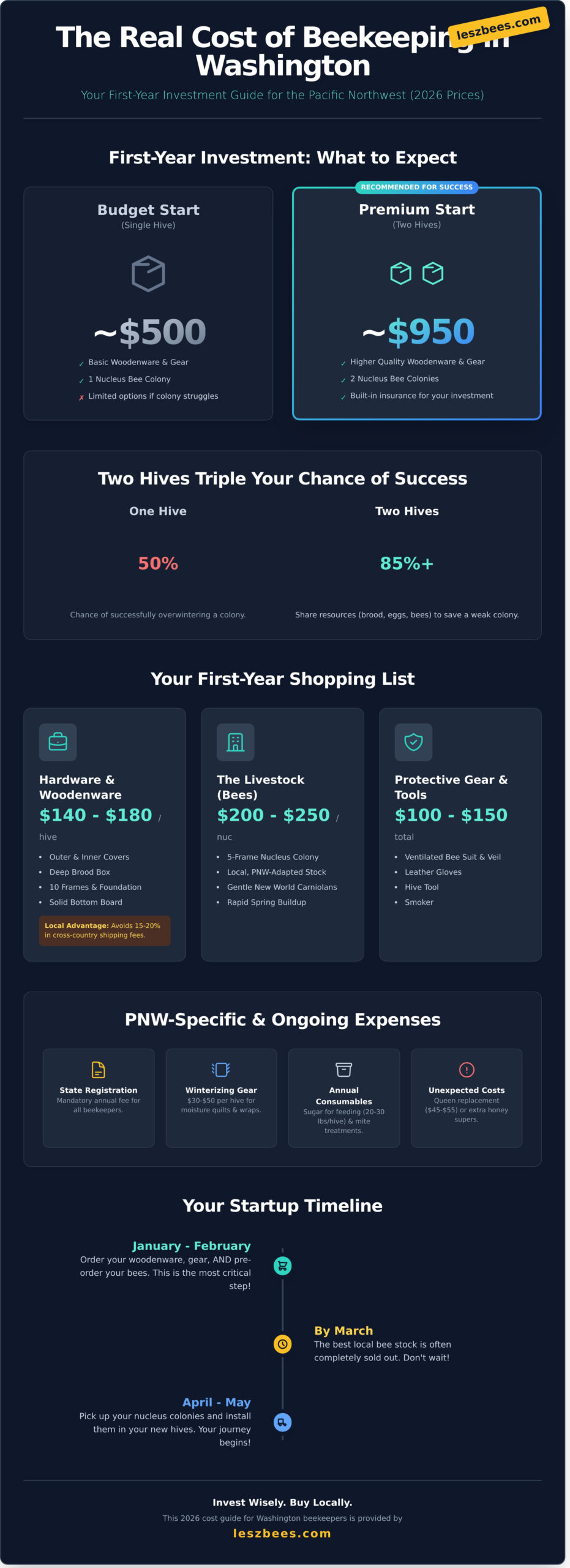
- Understand the full first-year investment, from a budget-friendly $500 setup to a premium $950 package designed for the Pacific Northwest.
- Get a detailed breakdown of the total cost to start beekeeping in Washington, including current 2026 prices for essential hives, tools, and bees.
- Learn why starting with a nucleus colony is the superior choice for our climate and what to budget for a healthy, local colony.
- Uncover the “hidden” expenses unique to our state, from mandatory hive registration to essential winterizing gear for damp Washington winters.
Total Investment Overview: What to Expect in Your First Year
Let’s get straight to the point. The total first-year cost to start beekeeping in Washington typically falls between $500 and $950. The lower end represents a budget-conscious, single-hive setup, while the higher end covers a premium two-hive start with better quality gear. This investment covers everything you need to get your bees through their first full season. The ancient practice of Beekeeping (or apiculture) requires a solid foundation, and your initial budget is that foundation.
Why are Washington costs sometimes higher than national averages? Two main reasons: shipping and climate. Most large beekeeping suppliers are located in the Midwest or on the East Coast. Shipping heavy woodenware across the country can add 15-20% to your equipment bill, a cost you avoid by buying from a local Washington source. Additionally, our damp Pacific Northwest winters often require specialized gear like moisture quilts or insulated hive wraps, adding another $30 to $50 per hive not always factored into generic startup guides.
I always tell new beekeepers the same thing: start with two hives, not one. It’s the single best piece of advice for a beginner. While it nearly doubles your initial cost for bees and woodenware, it more than triples your chance of success. If one colony struggles, goes queenless, or fails to build up, you can use brood, eggs, or bees from the strong hive to save it. With only one hive, your options are limited and expensive. Starting with two hives increases your odds of successfully overwintering at least one colony from around 50% to over 85%. Think of it as built-in insurance for your investment.
You can manage your investment by timing your purchases correctly. The best time to buy your woodenware and gear is in January or February. You get ahead of the spring rush. More importantly, you must order your bees during this period. Local Washington suppliers begin taking pre-orders for nucleus colonies (nucs) in January for pickup in April or May. By March, the best local bee stock is often sold out completely. Don’t wait.
The Three Pillars of Your Initial Budget
Your startup costs break down into three essential categories. Each is critical for a successful start, and I personally source quality options for all three right here in Washington.
- Hardware and Woodenware: This is the “house” for your bees. It includes the hive bodies, frames, bottom board, and covers. This is a long-term investment that should last for years.
- The Livestock: Your bees. We recommend starting with a 5-frame nuc of New World Carniolan bees, as their gentle temperament and rapid spring buildup are well-suited to the PNW climate.
- Protective Gear and Tools: Your personal kit. A quality bee suit with a veil, gloves, a hive tool, and a smoker are non-negotiable for safe and effective hive inspections.
Fixed vs. Variable Costs in the PNW
Understanding your budget means separating one-time purchases from recurring annual expenses. This helps you plan beyond your first year.
- Fixed Costs: These are your durable goods. Your hive boxes, smoker, and bee suit should last 5-10 years with proper care. This is the bulk of your initial investment.
- Variable Costs: These are annual consumables. You’ll need sugar for feeding in the fall (plan for 20-30 pounds per hive), and essential mite treatments like Apivar or Formic Pro.
- Unexpected Costs: Be prepared. You might need to replace a failing queen mid-season ($45-$55) or add a second honey super if you have a strong nectar flow ($35-$45).
The Hardware: Essential Equipment and Woodenware Costs
Your beehive is your bees’ home. It’s the single most important piece of equipment you will buy. The initial hardware investment makes up a large part of the total cost to start beekeeping in Washington. Here in Whatcom and Skagit counties, the 10-frame Langstroth hive is the industry standard. It’s what I use, and it’s what I recommend for its versatility and parts availability.
A major factor to consider is what I call the “Bellingham Advantage.” Beehives are heavy. Buying from a big online seller means you pay a premium to ship heavy pine boxes across the country. When you buy local, that money stays in your pocket or goes toward higher-quality gear. I take pride in keeping my prices low by cutting out that unnecessary shipping cost for you.
Standard Woodenware Pricing
A complete, unassembled single-deep hive setup will cost between $140 and $180. This typically includes:
- A telescoping outer cover and an inner cover
- One deep brood box
- 10 wooden frames with foundation
- A solid bottom board
Pay close attention to wood grade. “Budget” or commercial-grade boxes often have knots and imperfections that can worsen in our wet climate, leading to warping and poor seals. I only stock premium-grade woodenware from trusted suppliers like Beeline. It costs a few dollars more, but it won’t fall apart after two wet winters. Your bees deserve a durable home.
High-Performance Options: HiveiQ and Insulation
Traditional wooden hives work. But for beekeepers serious about overwintering success, a thermally superior hive is a smart investment. I carry HiveiQ systems, which cost around $250 for a complete single-deep setup. This isn’t a luxury; it’s a practical tool for our climate. The dense EPP foam construction provides an R-value of 7+, which drastically reduces winter condensation. Moisture, not cold, is the biggest killer of bees in Washington.
Think of it as a long-term cost-benefit analysis. Replacing a dead colony costs over $200 for a new package of bees. If a HiveiQ system prevents just one colony loss, it has already paid for itself. This is a critical factor in the real cost to start beekeeping in Washington over several seasons.
The Essential Tool Kit
Beyond the hive itself, you need a basic set of tools to work your bees safely and efficiently. The total cost for these essentials can range from $75 to over $200, depending on your choices. The WSU Extension beekeeping program estimates a total first-year investment of around $600 for a suit, tools, and a single hive, which shows how these individual costs add up.
Here’s a practical breakdown:
- Smoker: Don’t buy a cheap, $20 galvanized smoker. It will rust out in one season. A quality $40 stainless steel smoker with a heat guard is safer, lasts for years, and performs reliably.
- Hive Tool & Bee Brush: These are your primary tools for inspections. A sturdy hive tool and a gentle bee brush are small costs, around $10-$15 each, that make a huge difference in your workflow.
- Protective Gear: Your comfort level dictates your budget here. A simple pull-over veil costs about $20 and works well. For complete peace of mind, a fully ventilated bee suit costs about $160 but provides superior protection and keeps you cool during summer inspections. I personally choose and sell the gear I know works. You can view the complete woodenware and tool kits I recommend right here on my site.
Livestock Costs: Buying Bees in Washington
Your bees are not an expense; they are the single most important investment you’ll make. The quality of your bees directly determines your success rate. While it’s tempting to find the cheapest option, this approach often leads to frustration and a failed colony. The real cost to start beekeeping in Washington isn’t just the initial price tag, but the value and viability you get for your money.
For new beekeepers in our region, the choice is clear: start with a nucleus colony, or “nuc.” A nuc is a small, established hive, not just a box of loose bees. Forget about “package bees” shipped from California or Georgia. They arrive stressed, have no comb or resources, and struggle to build up during our cool, wet Pacific Northwest springs. I’ve seen too many beginners lose their entire investment by starting with a package. Your success is my priority, and that starts with strong, local bees.
In the Bellingham area, expect to pay between $200 and $240 for a high-quality, 5-frame nuc of New World Carniolan bees. This price reflects locally-raised bees that are already adapted to our climate and forage. It’s a premium worth paying for a colony that is already thriving.
Why Nucs are the Best Value
A nuc gives you a massive head start. It’s a functioning colony, ready for you to transfer into your full-sized hive. When you buy a 5-frame nuc from a reputable local supplier, you get:
- A proven, accepted, and actively laying queen.
- Approximately 10,000-15,000 bees, including workers, drones, and nurse bees.
- 3 frames of brood in all stages (eggs, larvae, and pupae).
- 2 frames of resources (pollen and honey).
- Drawn-out comb, which saves the bees weeks of work.
This established foundation dramatically increases your chances of success. It reduces the risk of your queen being rejected and minimizes the stress on the colony. Most nucs in Whatcom and Skagit counties are ready for pickup during a specific window, typically from the last week of April through the first two weeks of May.
Sourcing Queens and Genetics
Things can go wrong, even with a strong start. Your queen could fail, or you might accidentally damage her during an inspection. That’s why I recommend every beekeeper set aside an additional $40 in their budget for a replacement queen. Having this money ready means you can act fast to save your hive if needed.
The best bees for the Pacific Northwest are New World Carniolans. They are known for being gentle, overwintering well in damp climates, and being excellent honey producers. When you order your nuc or a replacement queen, you’ll often see two options: marked or unmarked. A marked queen has a small, colored dot on her thorax. This makes her much easier to find in a hive of 50,000 bees. Is it worth the extra $5? Absolutely. It’s a small price for saving time and reducing stress during hive inspections. Order your bees early, as most local producers offer “early bird” pricing before January 31st and often sell out by March.
Washington-Specific Requirements and Hidden Expenses
Your initial shopping list for a hive, bees, and tools is just the beginning. Here in the Pacific Northwest, our unique climate and local rules add a few extra lines to your budget. These aren’t just suggestions; they are essential for keeping legal and healthy bees. Understanding these items is key to accurately calculating the total cost to start beekeeping in Washington.
I see many new beekeepers get surprised by these costs after they’ve already bought their first nuc. Let’s get you prepared so there are no surprises.
Legal and Regulatory Costs
First, you must register your hives. The Washington State Department of Agriculture (WSDA) requires every beekeeper to register their apiary locations annually. This isn’t complicated or expensive. The fee is a flat $5 registration plus $5 per apiary location. For a backyard beekeeper with one location, that’s just $10 a year. This registration helps the WSDA monitor for diseases like American Foulbrood and protect our entire bee population. You also need to check local rules. Cities like Bellingham and Mount Vernon have specific zoning ordinances for beekeeping, often related to hive placement and lot size. A quick call to your city’s planning department is a necessary step.
Climate-Specific Gear for the PNW
Our wet, mild winters are the biggest challenge. Cold is manageable for bees, but dampness is deadly. This is why I tell every new beekeeper to budget for the “moisture tax.”
- Moisture Quilts: This is non-negotiable. A moisture quilt or a vented inner cover sits at the top of the hive, absorbing condensation and preventing cold water from dripping on the cluster. Expect to spend $20-$30 per hive on a quality quilt.
- Winterizing Supplies: You’ll need an entrance reducer to keep the hive warm and mouse guards to block rodents seeking shelter. These are inexpensive, typically under $10 for both, but absolutely vital for winter survival.
- Feeding Supplies: Our long, cool springs mean you’ll need to feed your bees. I recommend internal hive-top feeders over entrance feeders to avoid attracting pests. A good feeder costs around $15-$25.
Don’t let your bees get caught in a cold rain inside their own home. I personally stock all the winterizing gear and quality woodenware you need to keep your hives dry and healthy through a Washington winter.
Ongoing Health and Community Costs
Beyond the one-time purchases, you have recurring annual costs for hive health and your own education. The most significant is mite management. The Varroa destructor mite is the single greatest threat to your bees. You must have a treatment plan.
Plan to budget between $50 and $100 per year for Varroa mite treatments like Apivar or Formic Pro. Skipping this step will almost certainly lead to losing your colony.
Finally, join a local club. The Whatcom County Beekeepers Association membership is only $20 per year for an individual as of 2023. The value you get from local mentors, bulk buying opportunities, and monthly education is worth ten times that price. It’s the best investment you can make in your beekeeping success.
How to Save Money: The Les’s Bees Local Advantage
After outlining the equipment, bees, and accessories, you can see how the initial investment adds up. But the listed price isn’t the final price when you buy from large, out-of-state suppliers. The single biggest way to lower the cost to start beekeeping in Washington is to work with a local source. That’s where I come in.
Big online retailers have to ship heavy, bulky woodenware across the country. A complete 10-frame hive setup with two deep boxes can weigh over 60 pounds. Shipping that from a warehouse in the Midwest or on the East Coast to Washington can easily add $100 to $150 in freight charges to your order. By picking up your equipment directly from me in Bellingham, you eliminate that entire cost. That’s a significant saving you can put toward another hive or better protective gear.
My commitment is to keep this hobby accessible. I take pride in keeping my prices low, often much lower than the big online sellers, even before you factor in shipping. This isn’t just about saving a few dollars. It’s about a different philosophy. I call it the “Buy it Once” approach. The cheap hive kits you find online often use lower-grade pine with poorly milled joints. In our damp Pacific Northwest climate, that wood can warp and rot in just two or three years, forcing you to buy a replacement and perform a stressful hive transfer. My woodenware is built from quality lumber, designed to withstand Washington weather for years. You save money in the long run because you aren’t replacing failed equipment.
Finally, the most expensive piece of equipment is the one you don’t need. I see new beekeepers get overwhelmed by catalogs and buy fancy gadgets they won’t use for years, if ever. When you work with me, you get straightforward advice. I’ll help you get exactly what you need for a successful first year and nothing more.
The Local Source Difference
I personally choose every product I sell, from the grade of wood for hive bodies to the genetics of the bee nucs I offer. You aren’t buying from an anonymous warehouse. You are buying from a local beekeeper who uses this exact same equipment. This hands-on approach prevents expensive beginner mistakes. I can show you how the pieces fit together, explain why a solid bottom board is better for our wet winters, and ensure you go home confident and prepared. That personal guidance is something a national catalog simply can’t offer.
Getting Started Today
The best way to manage the cost to start beekeeping in Washington is to plan ahead. I begin taking spring orders for nucleus colonies and equipment in the winter. You can visit my Bellingham location to see the gear for yourself and get a feel for the quality firsthand. Get everything you need to keep healthy, productive bees right here in Whatcom County. Your satisfaction is guaranteed.
Check out our current price list for hives and bees and reserve your equipment for the upcoming season.
Get the Right Gear Without Overpaying
Starting your first hive is a significant investment. This guide shows that the total cost to start beekeeping in Washington for your first year can range from $500 to over $800, depending on your choices. The key is sourcing quality equipment and healthy bees without paying big-box retailers for unnecessary shipping and marked-up gear. You don’t need to buy the most expensive kit to be successful.
At Les’s Bees, I help new beekeepers get started right. I personally choose every product I sell and take pride in keeping my prices much lower than the big online sellers. I’ll help you select the exact gear you need for our Pacific Northwest climate. If you’re near Bellingham, WA, you can even pick up your order locally and save 100% on shipping costs.
Ready to build your first hive? Shop local beekeeping supplies and save on shipping. Your successful beekeeping journey starts here.
Frequently Asked Questions
Is it cheaper to build my own beehives in Washington?
Yes, you can save money building your own hives if you have the right tools and skills. A pre-built Langstroth hive kit often costs between $150 and $200. Sourcing and cutting the lumber yourself can lower that cost to around $50-$70 for materials. However, this doesn’t account for your time or the need for tools like a table saw. For most beginners, buying quality, pre-cut woodenware is a more reliable and efficient start.
How much does it cost to register as a beekeeper with the WSDA?
Registering as a beekeeper with the Washington State Department of Agriculture (WSDA) costs a total of $10 annually. This fee breaks down into a $5 beekeeper registration fee and an additional $5 per apiary location. The state requires this registration to help monitor the health of bee populations and control the spread of diseases across Washington. While this annual registration covers the basic requirement, be aware that certain optional services, like specific disease inspections requested by the beekeeper, may have additional associated fees. For the mandatory registration, budget $10 per year.
Do I need a full bee suit, or is a veil enough for a beginner?
A full bee suit is highly recommended for beginners. While a simple veil and jacket combination costs around $70-$90, a full ventilated suit costs closer to $160-$250. This extra protection provides crucial confidence when you’re first learning to handle bees. Feeling secure helps you stay calm during inspections, which is safer for both you and your bees. It’s a worthwhile investment in your safety and education.
How much should I budget for bee food and medicine each year?
You should budget approximately $50 to $100 per hive each year for essential food and medicine. This cost covers supplemental feeding and pest management. A 50-pound bag of sugar for making syrup can cost around $30-$40. Essential Varroa mite treatments, such as Apivar or Formic Pro, will cost an additional $30-$60 per hive for a full year’s treatment cycle. Planning for these costs is key to keeping a healthy colony.
Can I save money by buying used beekeeping equipment?
You can save money with used equipment, but it’s a major risk for new beekeepers. Used woodenware can harbor diseases like American Foulbrood, whose spores can survive for over 40 years. Saving $100 on a used hive isn’t worth losing your new $200 bee colony to a disease you can’t treat. We always recommend beginners start with new, clean equipment to give their bees the healthiest possible start and avoid costly problems.
Why are bees more expensive in Washington than in other states?
Bees are often more expensive in Washington due to high demand, transportation costs, and a shorter local breeding season. Our cooler climate limits the window for local queen rearing, so many bee packages and nucs are trucked in from warmer states like California. This shipping can add $20-$30 to the price of each colony. Strong demand from both backyard beekeepers and large agricultural pollinators also keeps prices competitive in our state.
What is the most expensive part of the first year of beekeeping?
The most expensive part of your first year is the combined purchase of the bees and the hive itself. A nucleus colony or a package of bees will cost between $180 and $250. A complete hive setup, including boxes, frames, and covers, adds another $200-$300. This initial outlay of nearly $500 per hive makes up the bulk of the total cost to start beekeeping in Washington, with tools and protective gear following behind.
Does beekeeping eventually pay for itself through honey sales?
Yes, beekeeping can pay for itself within two to three years from honey sales alone. A healthy, mature hive in Washington can produce 30 to 60 pounds of surplus honey per year. Selling that honey at a local price of $12-$15 per pound can generate $360 to $900 in annual revenue. This income can quickly offset your initial startup costs and turn your hobby into a self-sustaining, and even profitable, venture.